by Eric Verhaeghe — Le Courrier des Stratèges
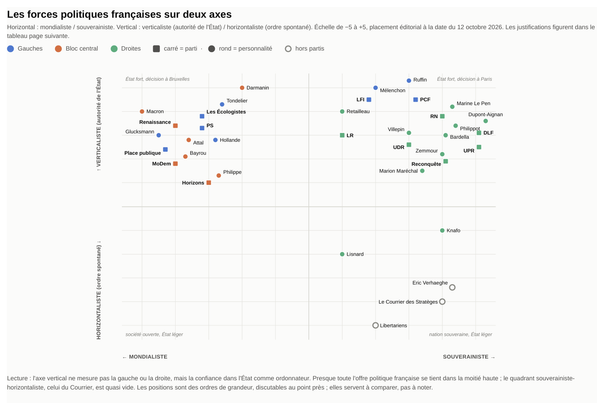
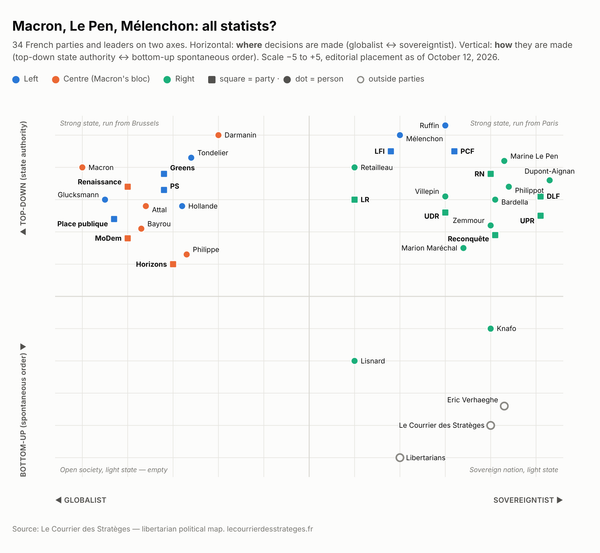
Six months before France's April 2027 presidential election, Macron sits at −5 on sovereignty and Mélenchon at +2: everything divides them. On the state, +4 and +5: nothing does. We placed 34 French parties and public figures on a two-axis libertarian map. Thirty-two of them sit in the top half. In the bottom right corner, there is almost no one. That is where we stand.
Thirty-four dots on a page
Emmanuel Macron, −5 and +4. Jean-Luc Mélenchon, +2 and +5. Marine Le Pen, +4.3 and +4.2. Bruno Retailleau, +1 and +4. On October 12, Le Courrier des Stratèges placed thirty-four French parties and public figures on a two-axis map, each axis running from −5 to +5, and the first finding is geographic: everyone is at the top. They fight fiercely over the horizontal axis, they trade insults over it, they campaign on it, and when the time comes to say what they expect from the state, they all find themselves at the same altitude.
Only two names drop below the midline on the sovereigntist side: David Lisnard (+1, −2), the mayor of Cannes, who talks about decentralization and shrinking the state, and Sarah Knafo (+4, −1), openly hostile to public spending. Below −2, only reference points outside any party remain: libertarians, who have no electoral offer in France, this publication, at +4 and −4, and the author of these lines, slightly above.
A map neither left nor right will draw
The left-right axis dates back to the summer of 1789: in the National Constituent Assembly, deputies who supported the king's veto sat to the right of the president, the others to the left. It served for two centuries. Today, it places Bruno Retailleau, the conservative leader, and Jean-Luc Mélenchon, the hard-left leader, at opposite ends of a line, while our map puts them at almost the same altitude, +4 and +5. And it says nothing about the one question a libertarian asks in front of a ballot: will this candidate decide in my place, and from how far away?
American libertarians hit the same wall. In the early 1970s, David Nolan drew a two-axis chart, economic freedom and personal freedom, to show that neither Republicans nor Democrats represented them. The Political Compass picked up the idea in 2001. Both tools measure what the state allows. They do not measure where it decides from. Yet that is the French question of 2027: a president elected in Paris, rules written partly in Brussels, and a farmer's hedge in rural Corrèze that has to go up to the prefect, the central government's representative in each department.
Hence this map, built for one specific purpose: to see, behind the quarrels of the horizontal axis, which floor each player stands on. It is published with this article, and anyone may challenge a position.
The positions are orders of magnitude. One could argue for former Prime Minister Édouard Philippe at +1.3 rather than +2, or for Éric Zemmour a notch higher. No one will pull the top half down. The map rests on two criteria, and only two. Here they are, because everything else follows from them.
First criterion: distance
The horizontal axis measures proximity. It asks a simple question: how far from the citizen is the decision made? At +5, no rule stands above national law. At −5, the nation is presented as an outdated level for the big issues. Emmanuel Macron has occupied that point since his Sorbonne speech of September 26, 2017, in which "European sovereignty" became the natural frame for defense, energy and currency.
The word globalism annoys people, and I take it in its strict sense, because it has been badly soiled. It does not designate a club, a conspiracy, or a category of people. It designates a doctrine, which can be read in public speeches: the right level of decision, for most things, is the most distant one. Sovereigntism is the opposite doctrine: the right level is the closest one.
Two words that are constantly confused must be told apart right away. A knife maker in Saint-Étienne who sells knives in Osaka is doing globalization. A single rule, written in Brussels or Geneva, setting how the Osaka maker and the Saint-Étienne maker must label their knives, is globalism. The first is an exchange, the second a command. One can like the first and loathe the second, and on reflection that is the most consistent position there is.
Second criterion: slope
The vertical axis measures slope. It does not ask where the decision is made, but in which direction it flows. Does it come from above, through decree, regulation, plan, prior authorization? Or does it arise sideways, through contract, trade, association, agreement between neighbors?
An example is worth more than a definition. Since October 1, a French farmer who wants to remove a field hedge must file a "single declaration" with the prefect (decree no. 2026-829 of August 28, 2026). He must justify the absence of an alternative, wait two months for review, replant at least the length destroyed, and, from 2027, respect a ban period of at least twenty-one weeks set by order. The text merges thirteen earlier regulations and is presented as a simplification. It is vertical from start to finish: the question of a hedge between two fields goes up to the prefecture and comes back down as a receipt.
This axis does not measure left and right. France Unbowed (LFI) and the Communist Party are at +4.5; the National Rally at +3.8; Macron's Renaissance at +3.4. Ecological planning, national preference and the strategist state do not have the same content. They have the same slope.
The two axes do not overlap
This is where the map bothers sovereigntists, and I count myself among them. Being close is not enough to be horizontal. The National Rally is at +4 on sovereignty and +3.8 on the state: national preference, retirement at 62, the protective state. Nicolas Dupont-Aignan is at +5.3 and +3.6, with reindustrialization planned from Paris. This kind of sovereigntism brings the signature back from Brussels to Paris, and keeps the decree.
French history knows this case well. Colbert, Louis XIV's finance minister, was a sovereigntist before the word existed: royal manufactures, production regulations, inspectors checking the width of cloth. The nation was close, orders fell from above, and the draper wove at the width set by the king. Nothing new about it; it is very French.
Lisnard and Knafo show that the opposite combination exists on the right. It remains rare, and it has no party machine.
Why the libertarian is first a man of proximity
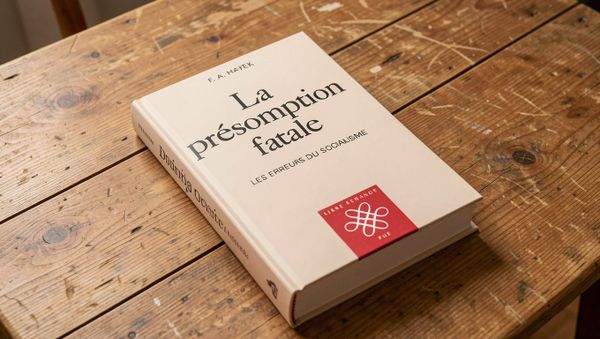
In September 1945, in "The Use of Knowledge in Society", Hayek made an observation no one has ever refuted: the knowledge needed for a decision is dispersed, local, often tacit. The baker knows what his oven is worth, the farmer knows where water pools, the craftsman knows what his customer will pay. No central bureau can gather that knowledge. Prices transmit it without anyone giving an order.
A rule of logic, not of taste, follows. If knowledge is local, the decision must be made where it lies. And the place closest to any decision that concerns me is me. Family, firm, town and nation come next, in that order, as levels of delegation. That is why French libertarianism speaks of individual sovereignty before national sovereignty: the second only makes sense as protection for the first.
The libertarian is therefore a sovereigntist by construction. He is one in a precise way: between decision-makers close to one another, coordination happens sideways, through contract and exchange. The liquid democracy we advocate is its political form: everyone votes himself, or delegates his vote, revocably, to whomever he chooses. Delegation starts at the bottom, and it can be taken back the next day.
Some will object that American libertarians defend global free trade, sometimes open borders, and look like globalists. The objection deserves better than a shrug. The answer lies in the distinction drawn above. Free trade is the most horizontal form there is: millions of contracts concluded without a center. It needs no world government. The Cobden-Chevalier Treaty of 1860, which opened trade between France and the United Kingdom, was signed by two sovereign nations, and it removed barriers instead of writing rules. A libertarian can want planetary trade and local decisions. What he cannot want is for the rules of trade to be written by an authority no one chose.
Why globalism cannot come down
Turn the logic around. A decision made for 450 million Europeans, or for eight billion humans, cannot know the hedge in Corrèze, the baker's oven in Lens or the order book of a subcontractor in the Jura. It can therefore take only one form: a uniform rule, applied everywhere in the same way, enforced by an administration. Distance requires rules, and rules require slope. A horizontal globalist would be a man who wants to decide everything from as far away as possible without imposing anything on anyone. He does not exist, and the map shows it: the bottom left quadrant is empty. The lowest point in the pro-European camp is Édouard Philippe's Horizons party, at +1.
The digital euro is a textbook case. Under the European Parliament's position, the holding limit would be set by the Commission, by delegated act, on the recommendation of the ECB. Parliament and the Council could object. They could not amend it. The amount of digital public money a French citizen will be allowed to keep will thus be decided three floors above him, by an institution he does not elect.
Federalists answer with subsidiarity, written into Article 5 of the Treaty on European Union: the Union acts only if the national level is not enough. It is their best argument, and it is worth looking at how it works. National parliaments can send the Commission a "yellow card" if they gather a third of the votes. Since 2009, they have done so three times. The Commission withdrew its proposal once, in 2012, on the right to strike. It kept its proposal twice, on the European Public Prosecutor's Office and, on July 20, 2016, on posted workers. In this system, the center decides what it leaves to the periphery. Subsidiarity, conceived this way, does not make power rise from below. It lets some of it trickle back down, when the top agrees.
That is the asymmetry. Proximity does not guarantee horizontality: the National Rally proves it. Distance does guarantee verticality: the empty quadrant proves it.
A crowded top half
It would be convenient to stop here and blame the political offer. That would be a bit of a lie. If almost everyone is at the top of the map, it is because voters are there too. Us, I mean. When diesel goes above two euros, we ask the state for a rebate, not for lower taxes. When a neighbor is a nuisance, we ask the mayor for a bylaw. When a profession worries us, we ask for prior licensing. Each of these gestures, taken alone, has its reasons. Put end to end, they draw exactly the map we deplore.
Verticality has its charm, mind you: it brings relief. Whoever asks for a decree no longer has to negotiate with his neighbor, or bear alone the risk of a failed contract. I suppose that is why it wins so often, and why it wins on both sides of the horizontal axis at once.
Last word
Thirty-four names on the map. Thirty-two in the top half. Two below the line on the sovereigntist side, and none below −2. None in the quadrant of horizontal globalists, because that quadrant cannot exist. Below −3, there is only a publication, its editor and a family of ideas that has no party.
In April 2027, every ballot on offer will bear the name of someone standing in the top half. The empty quadrant will not be filled by a vote. It fills up every time one of us settles with a neighbor what he was about to ask the prefect for.
How we scored
Each party or figure receives two scores from −5 to +5. The scale below says what each level means; the names are examples from the map. Positions are orders of magnitude, open to debate within a point: they are meant for comparison, not grading.
Horizontal axis: where decisions are made
| Score | Meaning | Examples |
|---|---|---|
| +5 | Full sovereigntism. Exit from the EU treaties, even from the EU and NATO. No rule above national law. | UPR, Debout la France, Philippot |
| +4 | Rupture sovereigntism. Stay in the EU but subordinate it: primacy of national law, national preference, referendums against Brussels. | National Rally, Reconquête, Le Pen, Zemmour, Knafo |
| +3 | Negotiating sovereigntism. Non-alignment, rejection of free-trade treaties, renegotiation rather than exit. | Communist Party, Ruffin, Villepin, UDR |
| +2 | Nation first, international horizon. Hostile to current treaties, but in the name of another supranational project ("social Europe", alter-globalism). | France Unbowed, Mélenchon |
| +1 | Europe by habit, nation by reflex. Accepts the European framework, challenges it case by case (immigration, farming, energy). | The Republicans (LR), Retailleau, Lisnard |
| 0 | Indifference. Where decisions are made is not an issue. | No major player |
| −1 / −2 | Pragmatic Europeanism. The EU is the natural framework, without an explicit federal project. | Darmanin (−2) |
| −3 | Committed Europeanism. More integration wanted: common budget, common foreign policy. | Socialist Party, Hollande, Horizons, Philippe, Greens |
| −4 | Federalism. The European level is the right one for most things: tax, defense, industry. The nation-state executes. | Renaissance, MoDem, Place publique, Glucksmann, Attal, Bayrou |
| −5 | "European sovereignty." The nation is explicitly presented as an outdated level for the big issues. | Macron |
Vertical axis: what is expected from the state
| Score | Meaning | Examples |
|---|---|---|
| +5 | Planning. The state sets prices, output and behavior; nationalizations, bans, a new constitution imposed from above. | France Unbowed, Communist Party, Mélenchon, Ruffin, Darmanin (on law and order) |
| +4 | Protective, commanding state. The state must "protect" and "restore order"; social spending and authority go together. | National Rally, Le Pen, Macron, Retailleau, Greens, Tondelier |
| +3 | Extended regulatory state. The market exists, but regulation comes first: the strategist state, agencies, sector plans. | Socialist Party, Place publique, Glucksmann, Renaissance, LR, UDR, Villepin, Debout la France, Bardella |
| +2 | Referee state. Fewer interventions, but order still comes from above; talk of "responsibility" without shrinking the state's scope. | MoDem, Bayrou, Zemmour, Reconquête, Marion Maréchal |
| +1 | Cautious decentralization. Loosen the state without shrinking it: local freedom, simplification, fiscal discipline. | Horizons, Philippe |
| 0 | Balance point. As much spontaneous order as commanded order. | No major player |
| −1 / −2 | Openly liberal. Declared reduction of the state's scope, spending cuts as a program, trust in local and private initiative. | Knafo (−1), Lisnard (−2) |
| −3 / −4 | Spontaneous order. The state limited to core sovereign functions and a few common goods; the rest goes to individuals, towns and contracts. Direct or liquid democracy. | Le Courrier des Stratèges (−4), Eric Verhaeghe (−3.4) |
| −5 | Minarchy. The state reduced to courts, police and defense, or less. | Libertarians |
Le Courrier des Stratèges is an independent French libertarian publication, founded and edited by Eric Verhaeghe. A former senior civil servant and business federation executive turned entrepreneur and essayist, he writes on the French state, surveillance, and the case for individual sovereignty.